
Waste Not: Circularity at Spacesmith
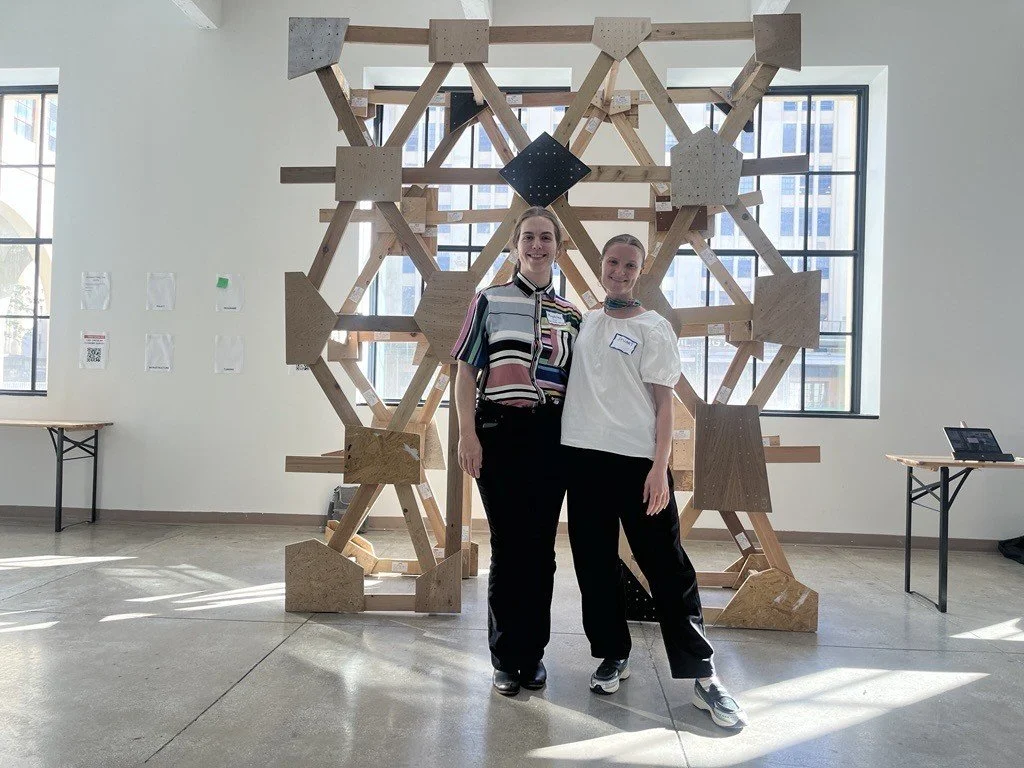
Magdalena and Stuart at the Construction & Demolition Reuse Summit at BATWorks.
When we, as an architecture and design firm, think about our role in climate change, one number rises above the rest: 7.7 million tons. That’s the amount of construction and demolition (C&D) waste from buildings produced in New York State each year, and it accounts for nearly half of our total solid waste by weight.
Like many construction projects in our city, Spacesmith’s work often takes the form of a renovation within an existing building. With each of these projects comes an opportunity to reduce the volume of materials being sent directly to landfill, and to approach the construction and demolition process with an eye towards all potential carbon emissions, starting from our first day reviewing the project brief.
Our team has long advocated for sustainable methods in construction, and many of our projects reflect a tailored approach to reducing waste. Recently, two members of our team have become instrumental in bringing a standard of circularity to all our current and incoming projects. Designers Magdalena Zink and Stuart Ingram both joined RECLAIM NYC as soon as they moved to the city – in 2023 and 2025, respectively – and later brought their insights to Spacesmith.
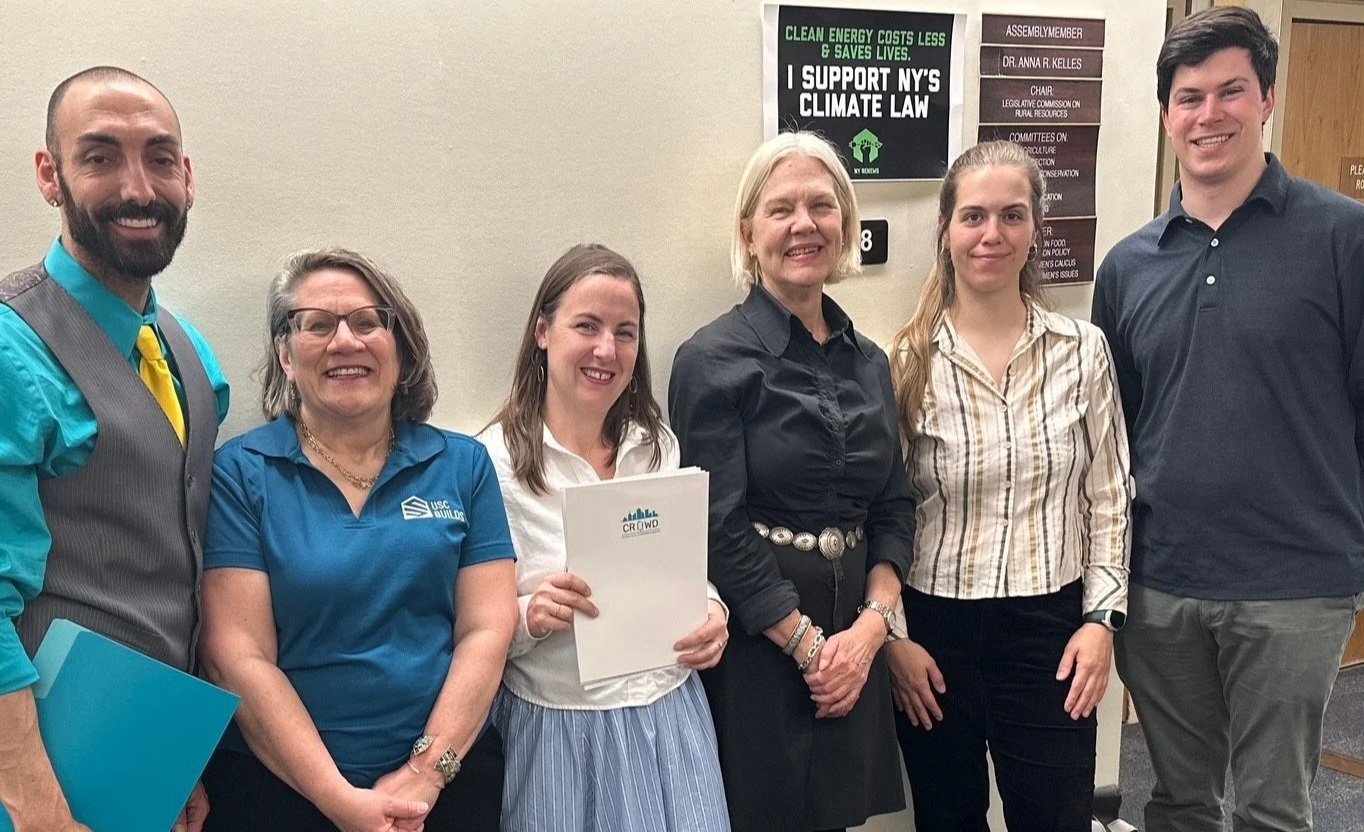
Magdalena and others from CR0WD in Albany for Legislative Action Day.
The name stands for The Reuse Exploratory Committee on Legislative Acts Impacting Materials, and is specific to New York City (CR0WD is a partner organization at the state level). Members of RECLAIM come from backgrounds in architecture, engineering, public policy, manufacturing, and sustainability, but they share a common goal. Each month, the group meets to exchange strategies and lessons learned from their own projects, all of them working towards reducing that 7.7 million tons.
When Magdalena joined RECLAIM several years ago, the group was small and scrappy. Each month, five or six members met at a bar to craft the white paper they would use to propose legislation on circularity in city council. Now, advocacy supplements action. The group has expanded into a vast network of sustainability pioneers, carbon experts, and AEC professionals helping each other through real projects, including several at Spacesmith.
Since joining the team at Spacesmith, Magdalena and Stuart quickly began sharing their learnings from RECLAIM and applying them to projects throughout the firm. Though many designers and firms share an interest in sustainability, circular construction methods and waste reduction, there exists no handbook, and new methods, technologies and partnership opportunities crop up every day. Our firm is seeing the benefit of empowering designers to bring these bold ideas to the fore – especially those that are plugged into New York’s networks of pioneers in circular thinking.
Recently, we’ve teamed up with Orbit, a new circular construction marketplace based in NYC that takes after tested models like the UK’s Material Index. By coordinating early on with the GC for the recent gutting of a retail space, Stuart helped divert dozens of furnishings and millwork pieces that were headed for the landfill into the hands of new owners without any additional cost.
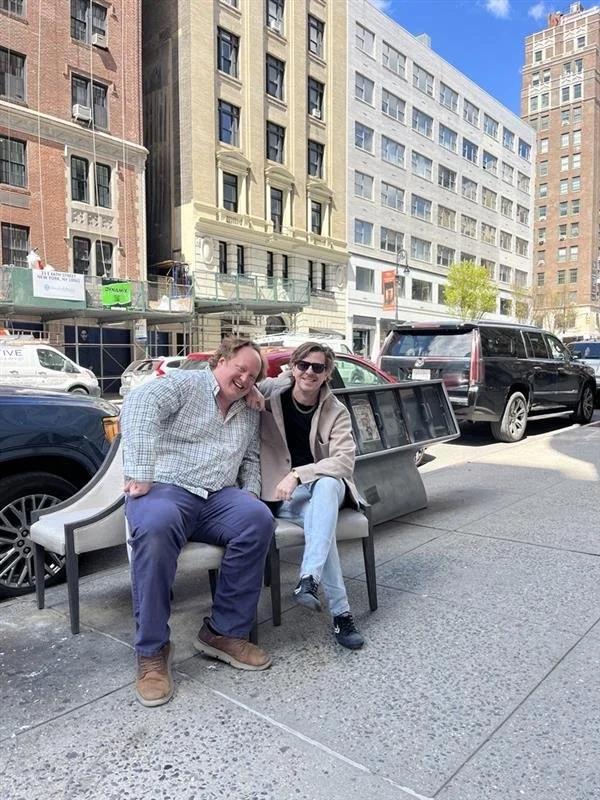
Isaac and Alex from Brooklyn Art Haus in their reclaimed chairs.
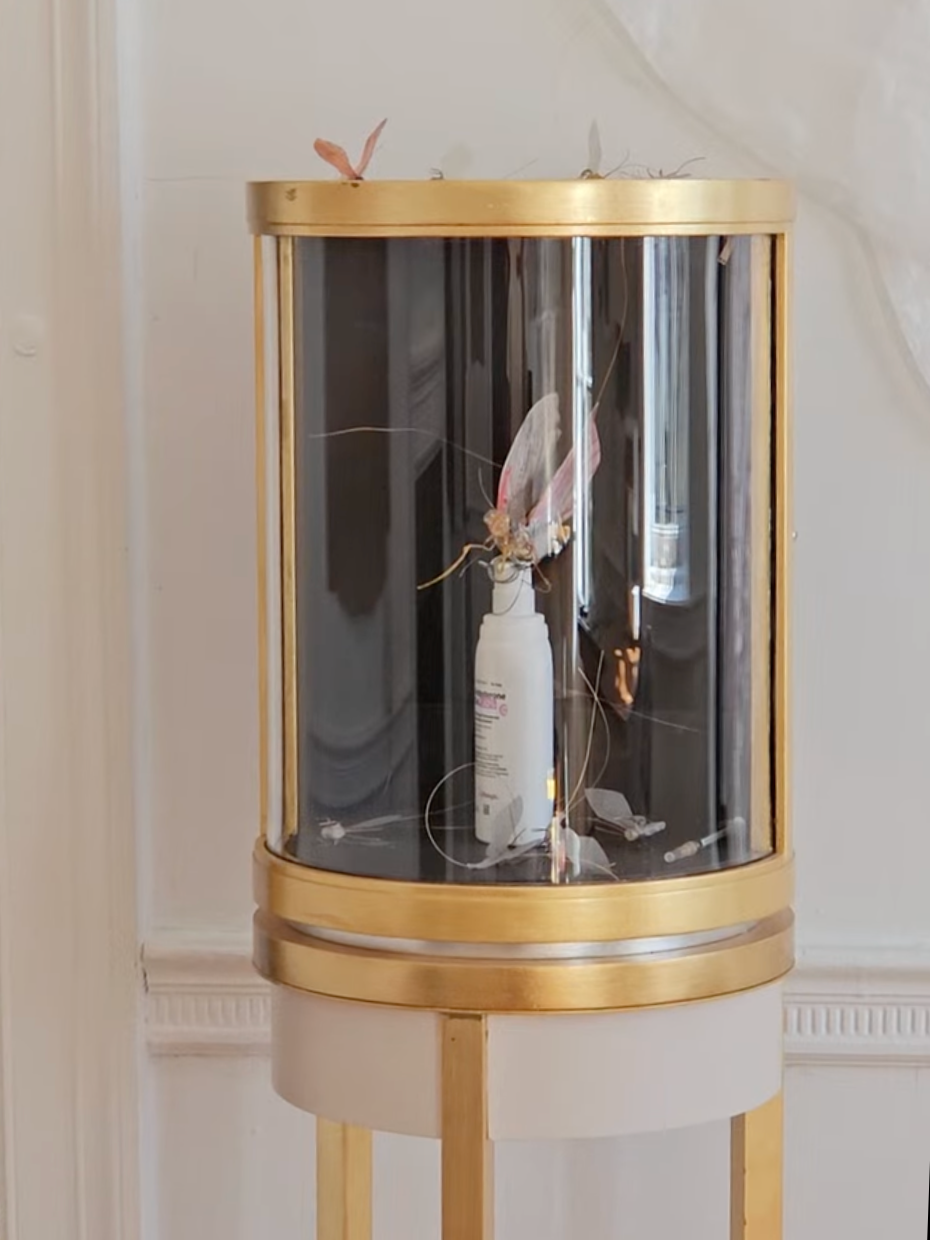
Camille, an artist in residence from Wave Hill, used this reclaimed showcase to display a puppet at an open studio.
Implementing these procedures can be as easy or budget-friendly as the outdated take-make-waste model of construction, but without the carbon cost . However, circularity does require mindfulness: our team takes the time to make an audit, deciding what can be donated or sold. Then, we share the item specs, field inquiries from interested reclaimers, and coordinate pickups. In some cases, organizations can give the donating entity a tax deduction. Part of RECLAIM’s mission is to remove barriers to entry, pushing for systems in which the most sustainable choice is also the simplest and most profitable.
On a larger scale, RECLAIM has the collective expertise to consult on and lobby for sustainable C&D policies at the city and state level. Last year, for example, the NYCEDC published its Circular Design and Construction Guidelines and began piloting them on a massive construction project at SPARC Kips Bay. Throughout the process, RECLAIM has offered itself as a brain trust for project managers from the NYCEDC, strategizing together to improve the guidelines in real time.
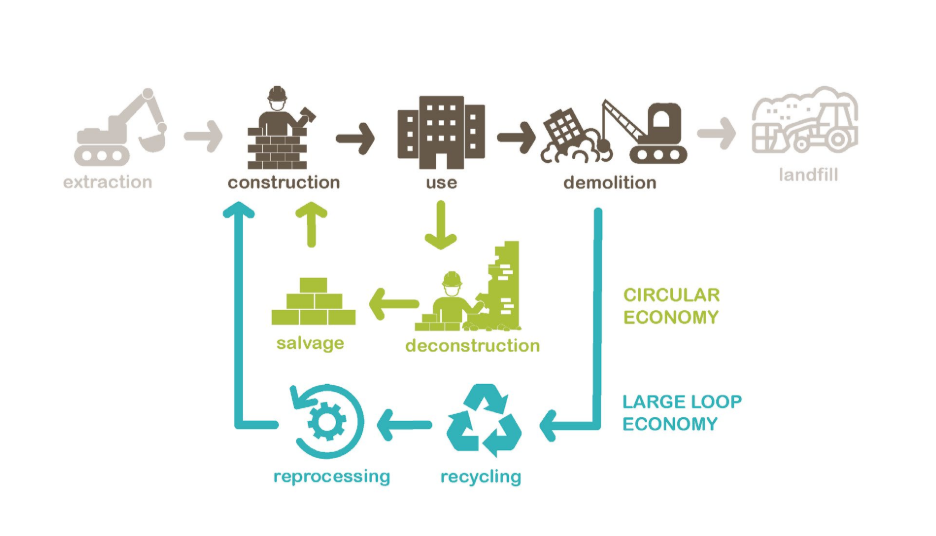
Illustration of circular construction methods, courtesy of RECLAIM NYC.
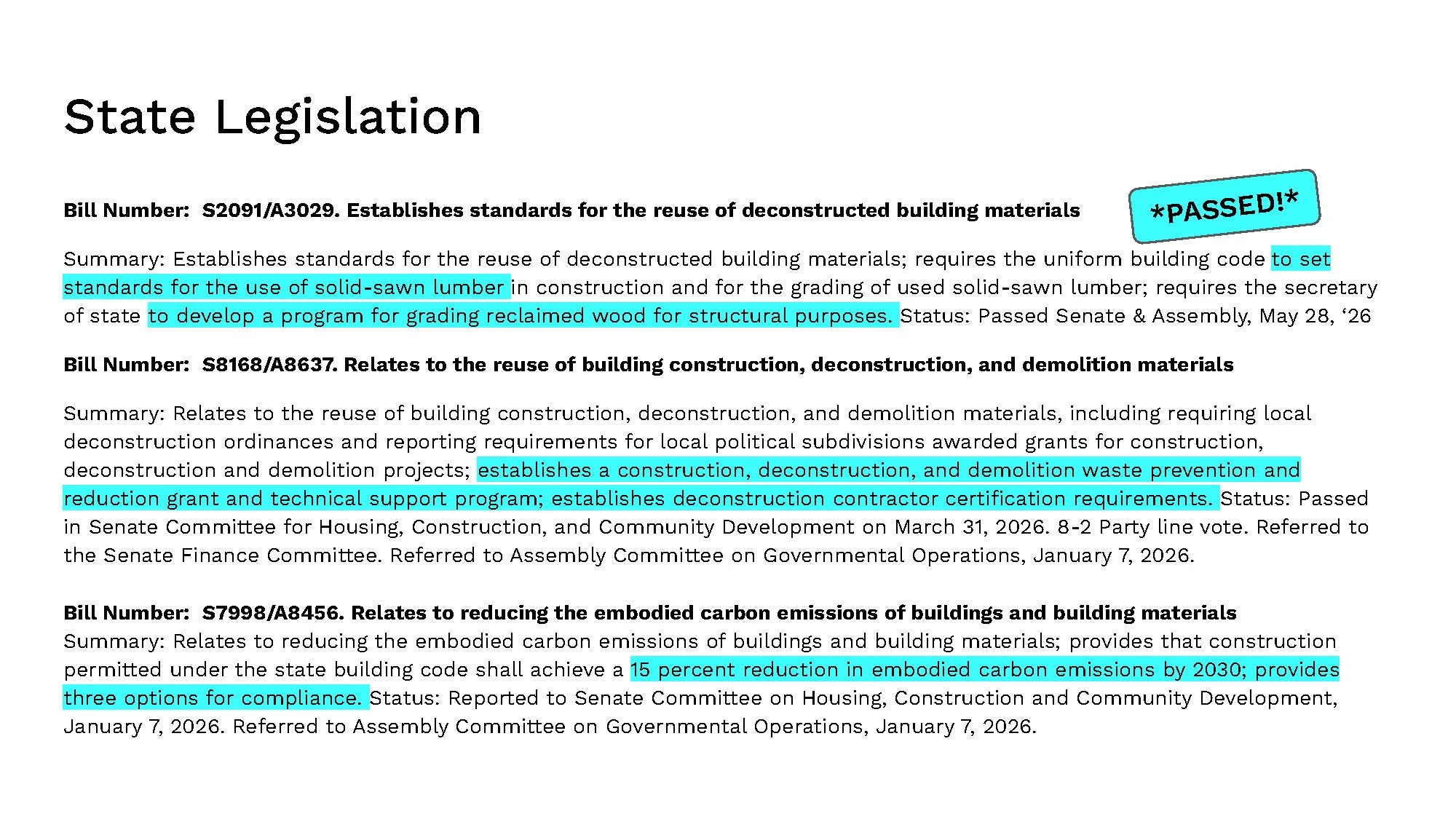
Circular construction bills proposed and passed with the help of CR0WD and RECLAIM.
With CR0WD, Magdalena recently traveled to Albany to meet with state legislators about proposed bills that aim to increase circular construction practices. CR0WD shared the undeniable incentives for deconstruction: repurposed materials could unlock $3 billion in economic activity, create 12,000 jobs, and divert millions of tons of waste over time.
Demolition waste has historically been a blind spot in the larger conversation about sustainability, but it’s a topic that impacts us in the AEC industry and beyond. Circular construction, by definition, requires the participation of many willing parties. Supply, labor, demand, intermediaries – these are all existing pieces of a chain just looking to be connected. Now, with organizations like RECLAIM providing resources to smooth the process, it’s easier than ever to become the missing link.