At Three UN Plaza, Spacesmith Recasts UNICEF's Front Door for Diplomacy and Action
On Manhattan’s east side, where First Avenue becomes a corridor of diplomacy, a transformation is taking shape inside Three UN Plaza. The Kevin Roche-designed tower, long a fixture of the United Nations campus, now houses two newly reimagined spaces for UNICEF — a redesigned Danny Kaye Visitor Center and a fully overhauled Labouisse Hall — both conceived by New York architecture and interiors firm Spacesmith.
The projects arrive at a pivotal moment. As these spaces open, Spacesmith is also serving as architect and lead designer on a sweeping $500 million redevelopment of One and Two UN Plaza for the United Nations Development Corporation. The firm is helping reshape the physical front door to one of the world’s most visible humanitarian networks.
At the center of this first phase is UNICEF, whose headquarters at UNICEF House introduce visitors to the organization’s mission before they ever sit down for a meeting. The redesign acknowledges that reality. The lobby and visitor center are now calibrated to communicate the scope and urgency of UNICEF’s work from the moment a guest steps inside.
“This project is rewarding on so many levels, bringing us in close collaboration with a mission-forward client entrusting us to handle a challenging transition and renewal,” said Ezra Zuidema, AIA, architect and project manager at Spacesmith. He describes the work as an extension of the firm’s experience supporting global organizations that see their physical environments as an extension of their values.
The unifying idea behind the redesign is growth — not as an abstract slogan, but as a spatial strategy. “The design concept is rooted in a simple idea: growth,” Zuidema said. “Just as UNICEF plants seeds of hope and change in communities around the world, these renewed spaces are designed to reflect this process — welcoming visitors, building trust and encouraging dialogue.”
In the Danny Kaye Visitor Center, that concept translates into openness and clarity. A central wall that once segmented the space has been removed, allowing circulation to unfold naturally and guiding visitors toward seating areas and gathering points. The first impression is anchored by a layered welcome wall featuring a three dimensional UNICEF logo and the organization’s mantra, “For Every Child.” It is direct without being heavy-handed.
Throughout the lobby, graphics and color do much of the storytelling. Portraits of children, highlighted by vibrant acrylic panels, line the elevator bays. Window graphics repeat the guiding mantra in multiple languages, underscoring UNICEF’s global reach without resorting to overt symbolism. The effect is personal. Visitors encounter faces before statistics.
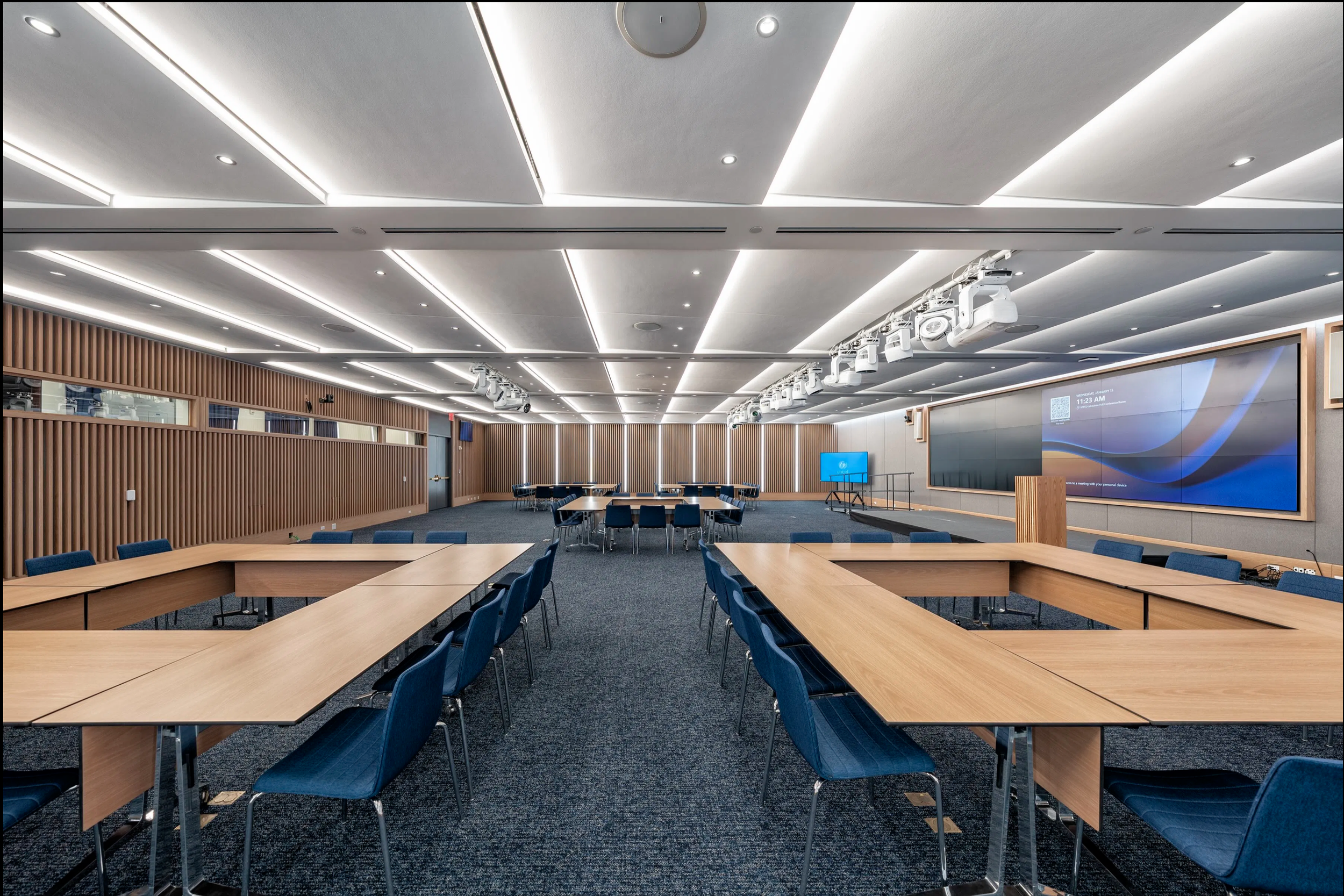
The material palette supports that tone. Acoustic felt and tackable wall panels introduce warmth while accommodating discussion and display. Overhead lighting is carefully composed, adding brightness without glare. In the adjacent cafeteria, flexible furniture arrangements — lounge seating, banquettes and café tables — create options for informal meetings and everyday work. Custom- patterned carpeting defines zones and softens the room’s scale.
Technology has been updated throughout, but it does not dominate. In both the visitor center and the conference room, new audiovisual systems are fully integrated into refreshed finishes. Glass doors provide acoustic control while preserving transparency. The spaces are designed to work hard, even when the focus is elsewhere.
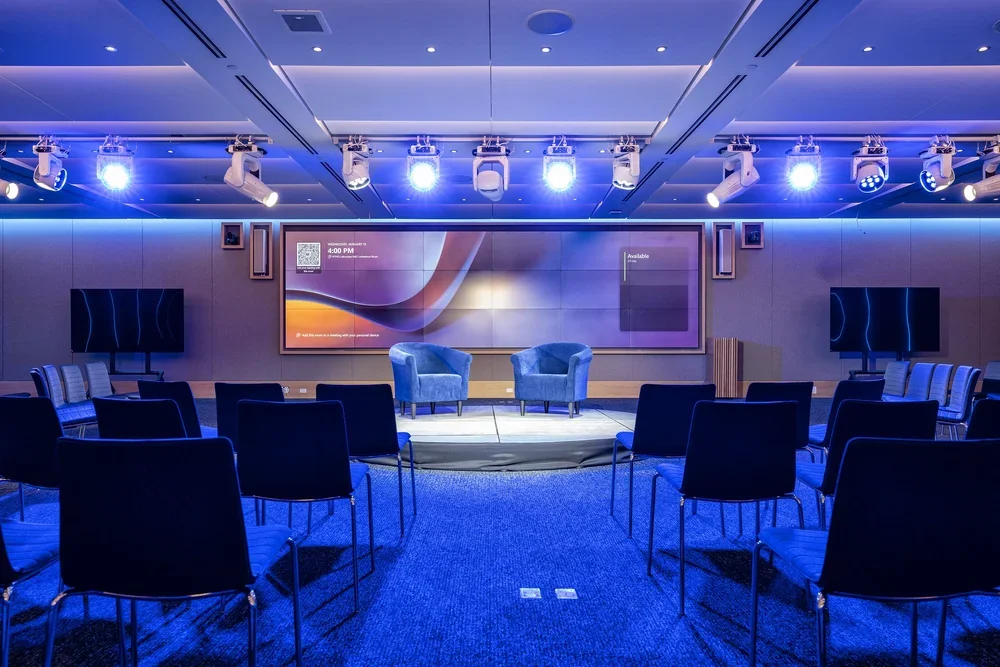
If the visitor center is about welcome and narrative, Labouisse Hall is about action. Named for diplomat Henry R. Labouisse Jr., the 5,400-square-foot conference and reception facility is where ambassadors, government officials and international leaders convene to advocate for children. Its redesign required a different set of priorities: flexibility, technical precision and sustainability.
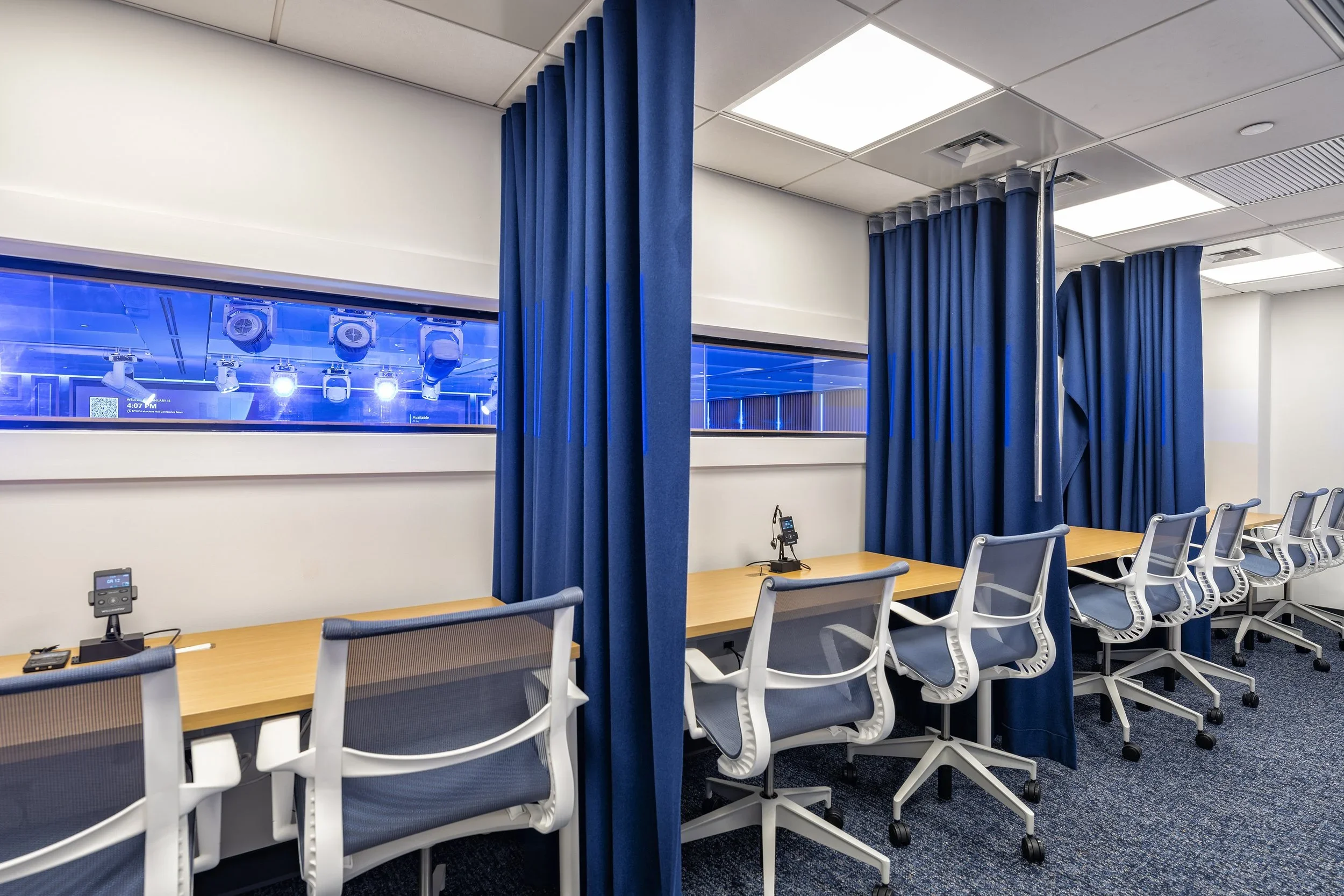
The renovation touches every component of the facility — prefunction space, main conference room and back-of-house areas including green room, control room and interpreter stations. Sustainability guided decisions to refresh and redeploy existing infrastructure wherever possible, aligning the project with UNICEF’s environmental commitments.
The material palette supports that tone. Acoustic felt and tackable wall panels introduce warmth while accommodating discussion and display.
The renovation touches every component of the facility — prefunction space, main conference room and back-of-house areas including green room, control room and interpreter stations.
The prefunction area now features illuminated exhibit walls developed in collaboration with Ralph Appelbaum and Associates, highlighting milestones in UNICEF’s global work. Custom millwork identifies Labouisse Hall while serving practical needs during events.
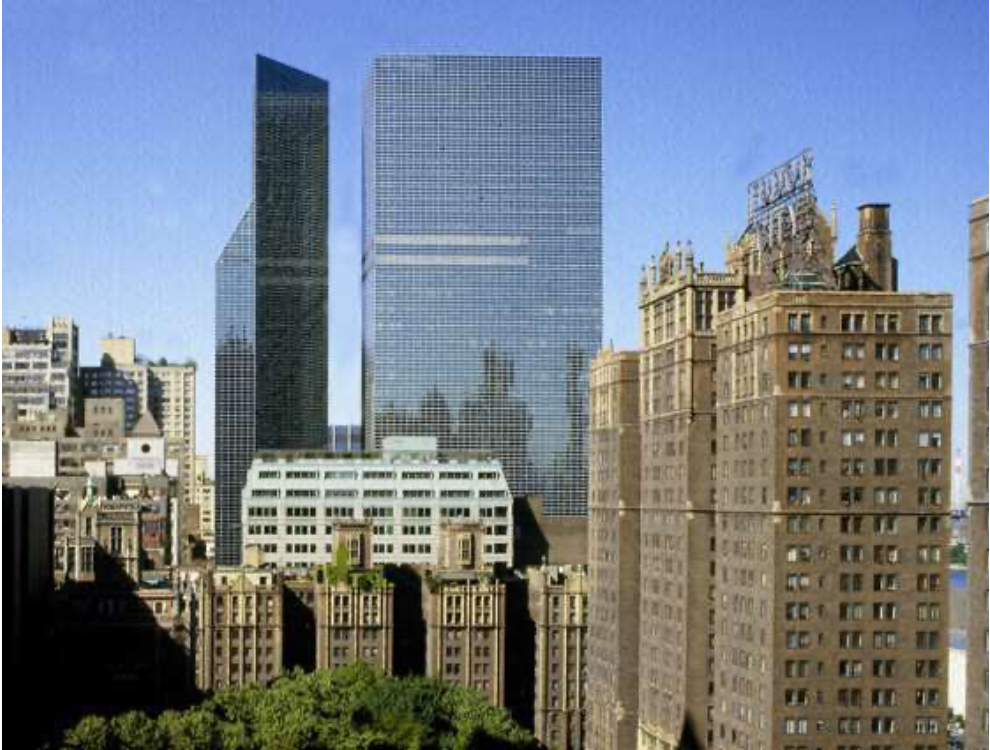
Spacesmith is also serving as architect and lead designer on a sweeping $500 million redevelopment of One and Two UN Plaza for the United Nations Development Corporation.
Inside the conference room, reconfigurable furnishings allow rapid transitions between board meetings and auditorium-style presentations. Advanced audiovisual integration — speakers, cameras, stage lighting and a large presentation screen — supports high-quality broadcasts and hybrid gatherings. In a building more than seven decades old, that level of coordination required careful technical planning.
Acoustics received particular attention. Decoupled sawtooth ceilings, wood-slat wall panels with integrated LED lighting and felt treatments fine-tune the room for clarity. The atmosphere is technologically capable yet warm — a balance not easily achieved in diplomatic settings.
Behind the scenes, interpreter rooms are equipped for simultaneous translation in the six official United Nations languages. Desk stations, acoustic curtains and upgraded equipment ensure that dialogue can flow without distraction. A new control room consolidates lighting, audio and video management, streamlining operations during high-profile events.
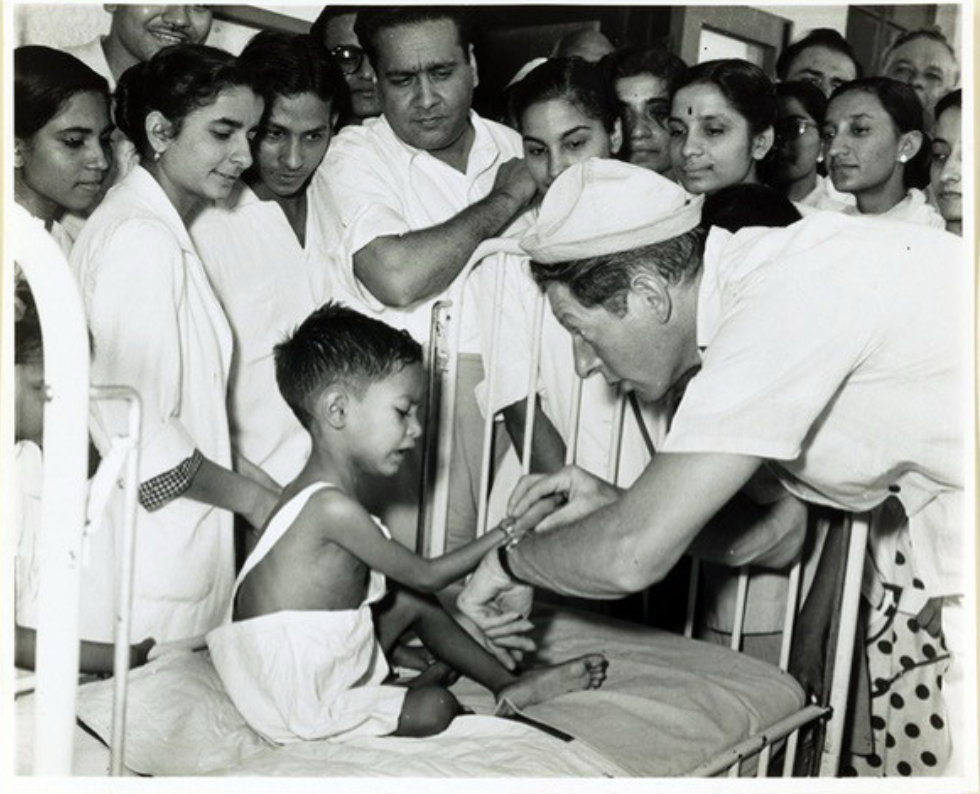
Danny Kaye supported UNICEF by serving as its first Goodwill Ambassador from 1954 until his death in 1987, pioneering the role to bring global attention to children’s needs. He traveled world-wide, promoting the “Trick-or-Treat for UNICEF” campaign, appearing in public service announcements and using his fame to raise funds and awareness for children’s health.
The broader redevelopment of the UN Plaza complex places these projects within a larger narrative of renewal. For decades, the campus has served as a hub for international collaboration. The current reinvestment signals an intention to keep those spaces relevant — technologically, environmentally and symbolically.
At Three UN Plaza, the result is measured rather than theatrical. The architecture does not compete with the mission. Instead, it frames it — offering a clearer introduction to UNICEF’s work and a more capable platform for the conversations that follow.
In a district defined by ceremony and protocol, the redesigned visitor center and Labouisse Hall focus on something more fundamental: creating environments where dialogue can lead to action. For UNICEF and its partners, that may be the most meaningful update of all.