The Female Perspective on Retail Design, Mentorship, and Inclusive Architecture Leadership

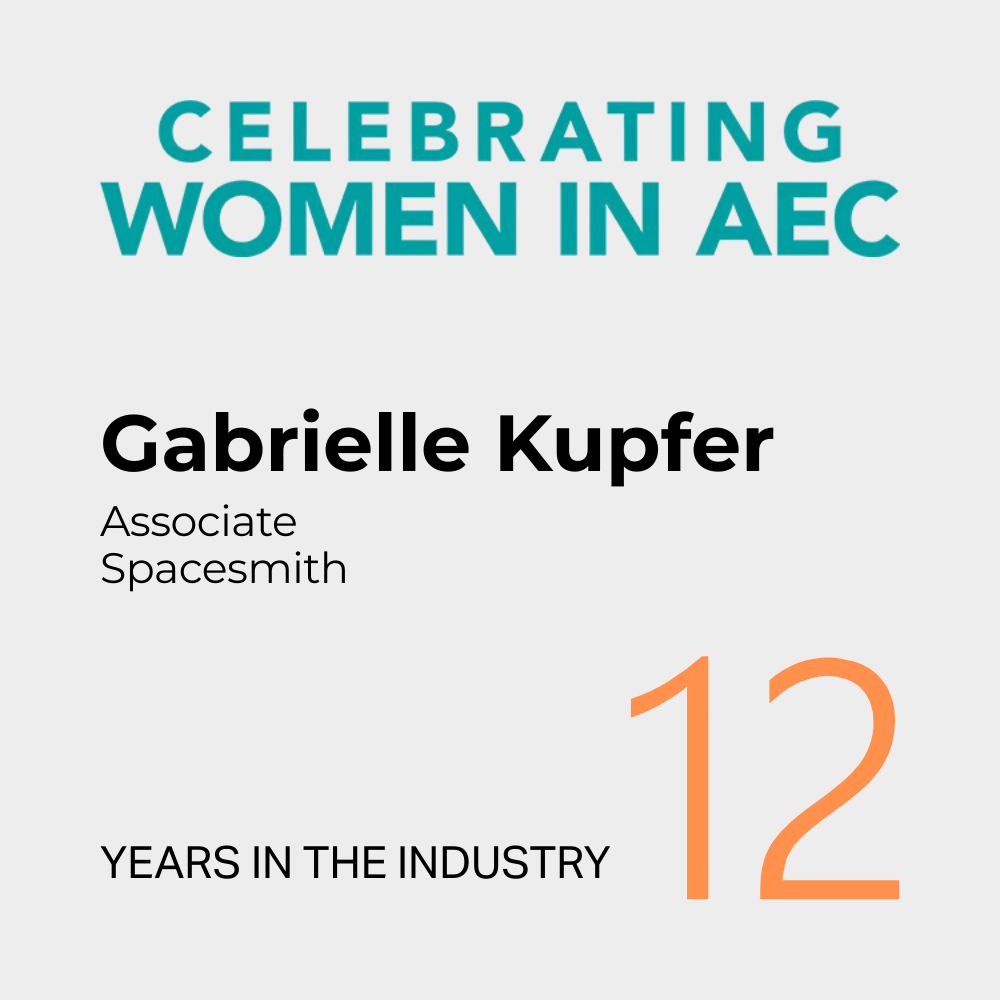
Gabrielle Kupfer, AIA, LEED AP BD+C
By Lindsay Lewis
March 2, 2026
What initially inspired you to pursue a career in architecture, and who or what influenced you most along the way?
The ability to use left and right brain skills is what inspired me. I came from a fine arts background in high school and early college, and I was deeply drawn to creative problem-solving.
Along the way, I’ve been fortunate to learn from many strong coaches, mentors, and leaders. Working alongside thoughtful teams and supportive colleagues has played a major role in shaping my approach and growth. In varied ways, my experience has reinforced the value of collaboration, adaptability, and design grounded in real-world use.
At Spacesmith, I’ve been particularly influenced by my colleagues Jaclyn Lieck and Amy Jarvis, senior associates who lead retail client relationships and projects with clarity and confidence. I’ve also benefited from the guidance of design leaders at my previous firms, BW Architects and Vocon, whose leadership helped shape my professional foundation.
Can you share a project you’re especially proud of and explain what made it meaningful—either professionally or personally?
I was part of the team that executed the Jessica McCormack US flagship project on Madison Avenue in New York City, where I served as project manager for Spacesmith. What made the project particularly meaningful was not only the design challenge, but the people behind it. The construction team, owner’s representative, and key consultants were all women-led businesses—and the client team itself was also led by women. Being part of a project driven by so many female leaders, each bringing deep expertise and creativity, was incredibly rewarding.
The building’s landmarked historic façade added another layer of complexity, requiring careful restoration of brickwork and windows. Navigating those constraints while delivering a refined flagship retail environment made the process both challenging and deeply collaborative.
How do you see diversity and inclusion influencing better design outcomes in architecture today?
Architecture and interior design depend on a carefully choreographed group of experts and specialists working together. When that group includes voices from different backgrounds and perspectives, the process becomes stronger and the outcomes more thoughtful.
We’re in a challenging moment for DEI conversations, but the value of inclusive collaboration is undeniable. Diverse teams consistently produce designs that are more responsive, more innovative, and more grounded in the realities of the people it serves. I hope we continue to push forward and protect space for those voices in our industry.
Have you had mentors or advocates who played a key role in your career growth, and how important is mentorship for women entering the field now?
I had a lot of great mentors. Early on, I studied with and interned for Margaret Ikeda and Evan Jones of the firm Assembly in Berkeley when I was a student at the California College of the Arts. I met up with Ikeda again when I was in San Francisco recently, and it’s become a lifelong friendship.
Today, the leadership team I work with at Spacesmith continues to be incredibly inspiring. Jane Smith, FAIA has done so much to build this company, and architect Michel Franck provides thoughtful guidance and coaching daily. It’s been so important to have people who are genuinely invested in my growth. There’s no such thing as a blank slate — people need a foundation.
How do you balance creativity with the technical, regulatory, and business demands of architecture?
I see those elements as fully interconnected — you can’t have one without the other. Creativity is shaped by technical constraints, regulatory requirements, and business realities, and those factors strengthen the design rather than limit it.
It ultimately comes down to listening: understanding the client, the brief, and the goals of the project. Architecture is a service industry, and good design grows out of that clarity.
What changes have you seen for women in architecture over the course of your career, and where do you think progress is still needed?
Licensure is critically important. I waited many years after graduating to begin the licensing process because it felt distant from my day-to-day work and long-term aspirations. As NCARB has made testing more accessible, I’ve seen more women engage with the technical aspects of design earlier in their careers, in part because the title now feels achievable. It’s exciting to see women stepping into more holistic leadership roles across the industry. There is still work to be done, however, particularly in providing state-recognized professional registration for the largely women-led practice of interior design. Many interior designers protect health, safety, and welfare in the built environment and deserve access to meaningful credentialing pathways.
I’ve also noticed more women engaging deeply with the technical aspects of design and construction earlier in their careers. That early exposure builds confidence and opens doors to broader leadership opportunities. It’s exciting to see more women stepping into holistic leadership roles—bringing together design, technical expertise, and strategic thinking.
How do you see the conversation on sustainability going in our industry?
It’s a very important conversation to have—and there are some very interesting innovations in happening in material practices, and it’s encouraging to see better options becoming available. At the same time, it can feel unsettling when market forces and economic models don’t mirror the urgency of our environmental crisis.
For me, sustainability is always top of mind, even on projects where the brief is to be cost-effective or design-forward. Having the opportunity to make informed material choices—such as specifying linoleum instead of vinyl at a comparable price point—can make a meaningful difference. That said, it is not just an upward curve, it’s up and down.
What has been the most fulfilling moment of your career so far, and how did it shape your professional journey?
There have been so many! Earning my license was a big moment, and being recently promoted at Spacesmith from senior designer to associate was an important achievement for me as well.
When you become licensed and registered, and you’re entitled to call yourself an architect, that’s a significant achievement. It’s both professionally validating and, honestly, clarifying. You no longer need to rely on euphemisms such as “spatial designer,” you can simply say what you are.
More recently, being promoted at Spacesmith from senior designer to associate has also been deeply fulfilling. It marked a moment of recognition and trust. Together, those milestones helped solidify my identity as an architect and shaped how I see my role moving forward.
What advice would you give to young women or girls who are considering a career in architecture or the broader AEC industry?
DO IT! When I was in school and told people I was studying architecture, they would say don't do it, it’s so hard. I found that very discouraging, and in hindsight, unnecessary. Yes, the work is demanding, but it’s also incredibly fulfilling and interesting. There are a lot of different roles in practice. If you’re curious about this field, it’s worth pursuing to see where you might fit and what kind of work excites you. Don’t let other people’s doubts define your trajectory.
During International Women’s Month, what does recognition like this mean to you, and how can the industry continue to better support and elevate women’s voices year-round?
Recognition like this is meaningful because it creates visibility—and visibility still matters. Recently, I was on a work call and realized I was the only woman on the Zoom. Moments like that are still more common than they should be, and they’re often paired with assumptions—about age, experience, or expertise—that many women encounter throughout their careers.
Continuing to be cognizant of who is in the room, who is speaking, and whose perspectives are being included makes a real difference. Actively ensuring that teams are diverse—and that not everyone comes from the same background or looks the same—leads to stronger collaboration and better outcomes across the AEC industry. That kind of awareness, practiced consistently, is how progress becomes part of everyday culture rather than a once-a-year conversation.